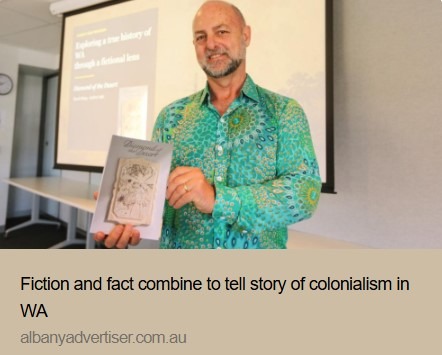
I’m just back from presenting my book to a local audience at the Albany ’26 bicentennial event series. I promised to ‘unpack five surprising facts about the early days of WA’, and from the reaction of the audience, that’s exactly what I delivered.
Here’s the full, relevant section from my talk:
Firstly, setting the scene: WA of course began with Albany, and Albany began as Frederick Town with the arrival of the Amity on Boxing Day 1826, establishing a NSW military outpost and the first settlement on the western coast of what was then known as New Holland. That decision was of course largely strategic, aimed at culling concerns that the French might otherwise seek to establish claims.
Then of course in 1829, the British took claim of the rest of WA as The Swan River Colony, incorporating and officially renaming Frederick Town as ‘Albany’.
Perhaps less well known are the broader policies and actions at that time in terms of relations with the Aboriginal people of Western Australia, as it came to be known. So here are five brief facts, which even came as a bit of a surprise to me as I researched those early days.
The first fact was that the British categorically recognised it as an invasion. WA’s settlement came towards the end of 400 years of the British colonial expansion and the newspapers of the time were awash with deep discussion of sovereign rights, and concern at England’s treatment of the native peoples in the newly claimed Antipodes and throughout the massive expanse of the British Empire. Enlightened Victorian philosophy saw this exactly for what it was – it was an invasion, and there were evident deep community schisms in both morality and law.
However, the invasion was justified through this same Victorian morality – that England was bringing civilisation and of course religion to the ‘untutored Lords of the Soil’. And so the second fact, of an overwhelming, pompous self-assurance that the British way was the only way – the right and proper way of the future, and the natives would surely come around to it soon enough.
Leading to a third fact that comes as a surprise to many – that the Aboriginal people of Western Australia were granted instant citizenship, and afforded all the rights of the English. The early WA constitution even set aside 1% of GDP for Aboriginal Advancement – not that it’s ever been applied. It was simply assumed that they would quickly adapt to a better way – the English way.
A fourth fact – that relations in both Albany and Perth were in fact quite good in those early days, and Aboriginal people were instrumental in the successes of the early colony. Learning from their experiences on the East coast, the Brits showed measured restraint here, believing that in time it would all work out. But there were inevitable conflicts and altercations as the Europeans gradually encroached on traditional lands, and bit by bit relations deteriorated, leading to the fifth fact, from whence things soon started to really fall apart – the decree of Captain Stirling and his Lieutenant Irwin that ‘the Natives need to fear us before they can love us’, a stance then ratified in law.
And a final fact that is important to understand alongside these early days – that WA was a failed and failing colony in the first two decades, and all but forgotten by the European powers within a matter of years. This fact is all important, because it reveals one of the biggest drivers of the problems that followed – the economy was on the brink of collapse. And everyone knows the thing that is most needed for an industrious economy is industrious people, which unfortunately the new settlers of WA were not. To the contrary, the early letters and news articles of the day record the people of the Swan Colony as a bunch of lazy drunks:
“the key skill of many of our locals is their ability to stay permanently drunk, and their uncanny ability to malinger even as their labour is in such demand” wrote one early settler.
“Along with selfishness” wrote another, “I might add alcohol is a blight on the colony. Many labourers are paid one-third of their wages in spirits and the rest in credit at a shop that sells not much else but spirits!”
Aboriginal people were much more numerous and in many ways more skilled and able than many of those early settlers. Letters of the early settlers describe them as tolerant, intelligent, peaceful and adaptable. From James Backhouse’s A narrative of a visit to the Australian Colonies 1839:
“The natives who are numerous about Perth, are a fine race, and show strong intelligence. They cut wood, draw water, and perform many other little offices for the European Population for which they obtain bread, or money, which they lay out in bread. They have not acquired a taste for tobacco, or spirits, nor do they show a disposition to wear English clothing. They are remarkably peaceful.”
Backhouse travelled from the East coast visiting many early towns and settlements along the way. This included Albany where he noted similar observations of the Aboriginal people. He concluded that compared with the established settlements in New South Wales and Tasmania, now nearly 5 decades old:
“From what we have seen and heard of those of the south coast, I incline to the opinion that many of the most atrocious vices of those in the older settlements are the result of a contact with a depraved, white population.”
The eventual expansion of the colony in the 1850s was also propped up by Aboriginal people alongside another class of cheap labour – newly introduced convicts. But while convict labour was free, Aboriginal labour was not – remember, ‘all the rights of the English’. As Aboriginal people resisted crimes against them and the destruction of their lands through the onslaught of new settlers from the south and then from the east into all corners of the state, acts like Blackbirding, along with state sponsored imprisonment, massacres and countless acts of horrid violence became common, and tribal economies and lore began to fall apart.
“Aboriginal groups were gradually displaced from their land by emerging cattle and sheep stations. Without access to traditional hunting grounds and water, their political and economic systems collapsed and they presented themselves for paid work wherever they could find it. Some became station hands, some worked the reefs – women were prostituted by their own elders. They only needed to pay them in alcohol and some food and water.”
Well, this ignominious history is ours I’m afraid. It shows a failure not just of Government, but foremost of individuals who failed to follow their moral compass, failed to do the right thing even as they built this great state.
This is the hardest truth of all – we can’t blame the British. Instead, we have to look much deeper and inwards if we hope to reconcile to that past and to the wrongs measured.
The good news is that is also the way forward, because the greatest barrier to reconciliation today is holding on to those exact same beliefs of the past – where today there is simply no excuse for them.
Acknowledge the truth; swear to never allow it again; show some respect to a people and a culture that we can all truly be proud of. And move forward, together.