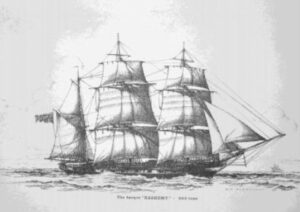
Continuing the WA’s Early Days series, today’s focus is on life aboard the colonial ships making their way from England – a 22,500 km journey that up to 1 in 6 did not survive.
The Diamond of the Desert describes the journey of the Hashemy in 1849, the second of 43 ships to bring convicts along with new settlers to WA’s far-flung shores. The journey is described firstly through Maggie’s happy letter to home; and then deconstructed with a description of actual life aboard ship. For the handful of first-class passengers, the 130 Steerage-class passengers and the 100 convicts who were crammed into the ships hold, on-board life soon became horrific as storms took hold:
Like most of those plying the route to the antipodes, this small ship The Hashemy had not been built with the transportation of people in mind. What had been cargo space had been hastily converted to ‘bulk’ accommodation, badly overcrowded and with poor ventilation. Rats were common. Sea water seeped in through hatches so it was constantly damp below deck.
The galley provided meals, but preservation of food was difficult and consequently meals were boring and monotonous. The menu consisted of salt meat and salt bacon, fish, cabbage, potatoes, beans and peas, in various combinations. Passengers had to collect their food from the galley and take it back to steerage to eat.
‘Steerage’ accommodation was essentially one large room that acted as dormitory, dining room and common room all in one. It was dark because there were no windows and a few dim lanterns hanging from the deck beams provided the only light. Passengers’ beds were crammed into bunks, stacked one atop another with barely enough room to even turn over. The Hashemy had only two common toilets on the upper deck for the steerage passengers, and people would shower in a sectioned area with cold sea water drawn up by crew. Most people it seemed preferred to not shower at all, or at least to leave it for a couple of weeks.
During the storm and the several more that followed, the crew would ‘batten down the hatches’, which for the steerage passengers meant that they would be locked below in an attempt to ensure their safety and to minimise water intake. However, this meant the toilets were now inaccessible and so they had instead been provided with pails which were to be emptied only when the conditions permitted. Of course, several pails were not secured and so with each violent roll, somewhere down below one or more buckets would tip, spilling their contents across the floor. Vomit, urine, faeces seeped into cracks and crevices. With no ventilation the smell became unbearable but worse, laden with diseases, and it wasn’t long before diseases spread, including cholera. The rats which had previously skittered past had become more brazen, and much more numerous. Barely anyone escaped without some form of illness – trenchmouth, ulcerations, scabies and headlice were common as the unsanitary conditions set in, and with the body lice deadly typhus too set in.