Diamond of the Desert is a historical adventure-romance story of early colonial Western Australia. Released to coincide with WA bicentennial events, 2026-2029, The Diamond relays an accurate history of first decades of The Swan Colony and its northerly expansion in the 1850’s through an engaging romance-adventure historical fiction.
Continuing the ‘WA’s Early Days’ series, today’s focus is on Perth and Fremantle in the 1850s. Far from the cosmopolitan venue it is today, both the locals and the appearance of Fremantle itself caused many new settlers to question their wisdom in making the trek across the globe:
“Fremantle was a dreary and unkempt place, where dwellings and gardens were unruly and where many of the men seemed to be permanently drunk, or perhaps just stupid.
The town is situated behind a little promontory of limestone, at the mouth of a large estuary called Melville Water into which the Swan and Canning Rivers flow. Fremantle resembles some of the little coastal villages on the limestone of county Durham, but it is even whiter than they, and it is greatly inconvenienced by the constant drifting of sand. The population in Fremantle was and remains today at about 200, all living in houses made of local limestone. Many of them have been left unfinished in consequence of the seat of Government having been removed to Perth, which is further up the river. These houses as well as those that are occupied are all going to decay.
Much of the country around Fremantle is limestone covered with sand; it is unproductive of herbage and unlikely to yield anything for the support of a new colony, though with a little preparation it is said to yield good vegetables. In particular potatoes are excellent, and in some situations produce three crops in a year. Vines and figs also thrive, even in the town where the limestone rock is covered with little but soil fragments and sand.
Yet it is clear that industry is not great in Fremantle, and much of the land will yield nothing without it.”
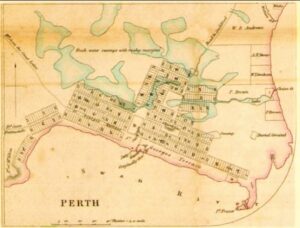
Impressions of the new Capital, Perth, didn’t fair much better:
“The town of Perth consists of several streets, in most of which there are as yet but few houses. Some of these, as well as the fences about the gardens, already appeared to be going to decay. The streets are of sand mixed with charcoal from repeated burning of the scrub which formerly covered the ground on which the town stands. The principal street has a raised causeway, slightly paved, by which the toil of wading through the grimy sand may be avoided.”
If you’d like to read more, the above is modified from original letters of such as James Backhouse’s A narrative of a visit to the Australian Colonies 1839 and J. Giles Powell’s The narrative of a voyage to the Swan River 1831.
…The early settlers must have wondered what they had got themselves into!