Author’s Blog 8 June ’26:
The North-West Stock Route – pt2: ‘The European march over the land’
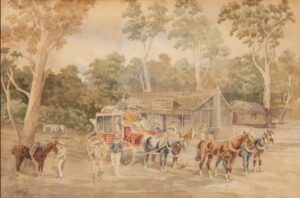
Pleased to see The WA’s Early Days series continuing to gather interest! Last week’s focus was on the first of three sections on the North-West Stock Route from Toodyay to Geraldton. After Dandaragan, the Route got even more interesting.
The ‘Diamond of the Desert’ is an actual location roughly halfway between Toodyay and Geraldton. I simply had to name my book The Diamond of the Desert after discovering the parallels in Sir Walter Scott’s Talisman and the march of WA’s early pioneers:
“Beyond the Gully, shrub-covered sand plains stretched before them, a seemingly endless coastal plain covered only by low lying scrubs and banksia trees. It was hot, and people struggled – those that had not replenished their water fully at the Hill River found the going tough, and pestered others for water and refreshment, complaining of the unrelenting sun and heat.
So it was a great relief when Burges called that they were approaching an ‘oasis’ that the previous group had found. James saw now a higher tree line from afar, rising above the surrounding scrub. There were Zamia palms around the perimeter and as they approached closer they could see magnificent, tall Eucalyptus grandis alongside casuarina and wattles. They eventually arrived at a recessed area of limestone caves and rocks – a quiet, strikingly beautiful and somewhat mysterious place.
They again stopped here for a day’s rest, and as Maggie explored she found Aboriginal artefacts scattered here and there – spear heads, rocks, broken baskets.
Maggie could sense the magic of this place and as she listened and placed her hand on the walls of the caves, she felt she could hear the memories of song and celebration – she knew then that this was a place of great significance to the Aboriginal people.
She could see too the evidence of 4000 hoofs that had trampled much of the soft ground six months earlier, and watched with dismay as the smaller flock with them now did exactly the same.
The convicts were set to work here building timber troughs on the edge of the spring for stock and they marked out an area for stock yards nearby. Three of the convicts were to remain here to clear trees and fence the yards for future settlers.
But for now at least, for one last time this place was one of reverence and intrigue. She sat in the shade, watching the contrast going on around her: A place that seemed deeply spiritual, steeped in Aboriginal lore; now trampled by cattle and men, who bathed from the cooled spring and soon started to drink and swear and to turn it to a place of commerce – a staging post for the European march over the land.
Something about the place reminded Maggie of a famous book from the time, “The Talisman” by Sir Walter Scott. It was a tale of the Crusades that positioned the English monarch Richard the First against Saladin, the Eastern Sultan. While Richard as the Christian and English monarch professed to civilised ways, he showed all the cruelty and violence expected of an Eastern sultan, while Saladin, on the other hand, displayed the deep prudence expected of a European sovereign.
As she witnessed the mysterious place now being trampled and changed forever, Maggie reflected that here again was a clash of cultures, and that ‘men of civilisation’ were once more those who showed the traits expected of those they claimed superiority over. She recalled that the whole sorry saga had come to a head with a great duel at a desert oasis called ‘The Diamond of the Desert.’
“The Diamond of the Desert!” she mouthed quietly to herself. She was overheard by one of the other travellers, who repeated the name more loudly and before long, everyone was stating the name and laughing at how appropriate a name it was.
And so this oasis of unexpected beauty, midway on the Stock Route that would see the unrelenting flood of settlers to Western Australia’s Midwest and beyond, became forever known as ‘The Diamond of the Desert’ – never attributed to Maggie, nor to the dark thoughts she held in whispering those words.”
A cause for reflection as National Reconciliation Week 2026 draws to a close.